
On Walking, Wordsworth, and the Creative Spark
by Rachel PIttman · February 16, 2026
When I was an undergraduate student, one of my Creative Writing professors gave our class an assignment to “go outside.” There were, of course, more instructions (we were to take a notebook, choose a living subject whether it be a bird, a tree, or a person, and write about them), but the heart of the task was to be outside. To escape the desks and linoleum floors and fluorescent lights that characterize the typical university classroom. It was a liberating exercise, but before the liberating part, it was uncomfortable. A disruption of the routine where twice a week we would sit in our workshop classroom and talk about Cormac McCarthy’s The Road and Lorrie Moore’s short stories.
Georgia Southern boasted a beautiful campus, with huge oak trees that lined each side of the red-brick Pedestrium. The oaks offered cool shade for the spring and summer months. Across from the library and beside the dining hall sat a glittering pond where ducks and turtles lurked, hoping for a morsel of leftover dining hall food. As a right of passage, many first year students would oblige.
On the day my professor gave us the assignment to find a living subject, I spent the first thirty minutes just walking. I was indecisive. I wanted to write about the ducks in the pond, but then I saw a group of sorority girls with perfectly curled blond hair and their rich-girl outfits (I know, how stereotypical!). I wanted to write about the group of philosophy professors smoking behind the English building, but then I saw the unicycle guy. Then I saw the guy who always walks around with a boombox, performing screamo music on his way to class. As I walked and watched the people around me, I was overwhelmed with possibilities.
I’d considered myself a frequent flyer on the Writer’s Block Airline, but a thirty-minute walk around campus showed me that there were more things to write about than I could possibly explore in a dozen lifetimes. Where to even begin?
I walked from my classroom all the way to the east side of campus, and then back to the west side. I finally settled on a subject: a blond-haired boy who had climbed part of the way up one of the trees. He’d shucked his t-shirt, and it lay on the grass below the tree limb where he lounged. I invented a name, a backstory, and a plot. I decided what this stranger wanted and created obstacles standing between him and his desire. I wrote it all down in my notebook, while sitting on a bench, sweating under the sun.
Wordsworth & Daffodils
In her essay “Wordsworth, a Wandering Poet: Walking and Poetic Creation” Florence Gaillet-De Chezelles cites one of Dorothy Wordsworth’s letters, where Dorothy observed her brother’s walking habits:
“At present he is walking, and has been out of doors these two hours though it has rained heavily all the morning. … He generally composes his verses out of doors, and while he is so engaged he seldom knows how the time slips away, or hardly whether it is rain or fair.”
I have to confess: I envy Wordsworth for his commitment and persistence. Even in the rain, he would walk for hours. Most days, if I decide to go for a walk, I’m taking my phone to track the distance, I’m listening to a podcast or an audiobook. I haven’t made it a habit to leave my phone at home and open my eyes and ears to my surroundings. I am nothing like Wordsworth. I’m too impatient, too anxious about emails and grading papers. When I feel the sky and the trees calling me to come outside and walk, I hesitate and hover over my computer. Most days, I remain tangled up in tasks, thinking, If I just finish this essay, I can take a break. If I just get through a dozen student papers, then I can go for a walk.
Outside, the eastern bluebirds and towhees are shuffling among the leaves. The mourning doves are calling from the branches.
In my senior year as an undergraduate, I studied abroad for a spring semester in the United Kingdom. I was in a small cohort of Georgia Southern students who attended Sheffield Hallam University in Sheffield. Aside from occasional meetups for dinner at a pub near the campus, I hardly saw the other American students. I was the only English major; the rest of them were pursuing degrees in Computer Science or Business. By necessity, I was alone most of the time in Sheffield.
Carless and unwilling to pay the bus fare, I walked everywhere. I’d leave my apartment at 8:15 in the morning, to walk across the city to the university campus. In January, it was pitch black, and the sun wouldn’t rise until after my class began at 9:00am. This was the furthest north I had ever been, and the short winter days were disorienting. On these walks, I practiced hypervigilance. I walked fast, constantly glancing behind me. Growing up in rural south Georgia, I’d been taught by my parents that cities were dangerous. Growing up as a girl, I’d learned from experience that men were dangerous. But, those freezing, dark winter months shed their coats, and suddenly it was April. The sun would rise earlier each morning, and my walks looked completely different.
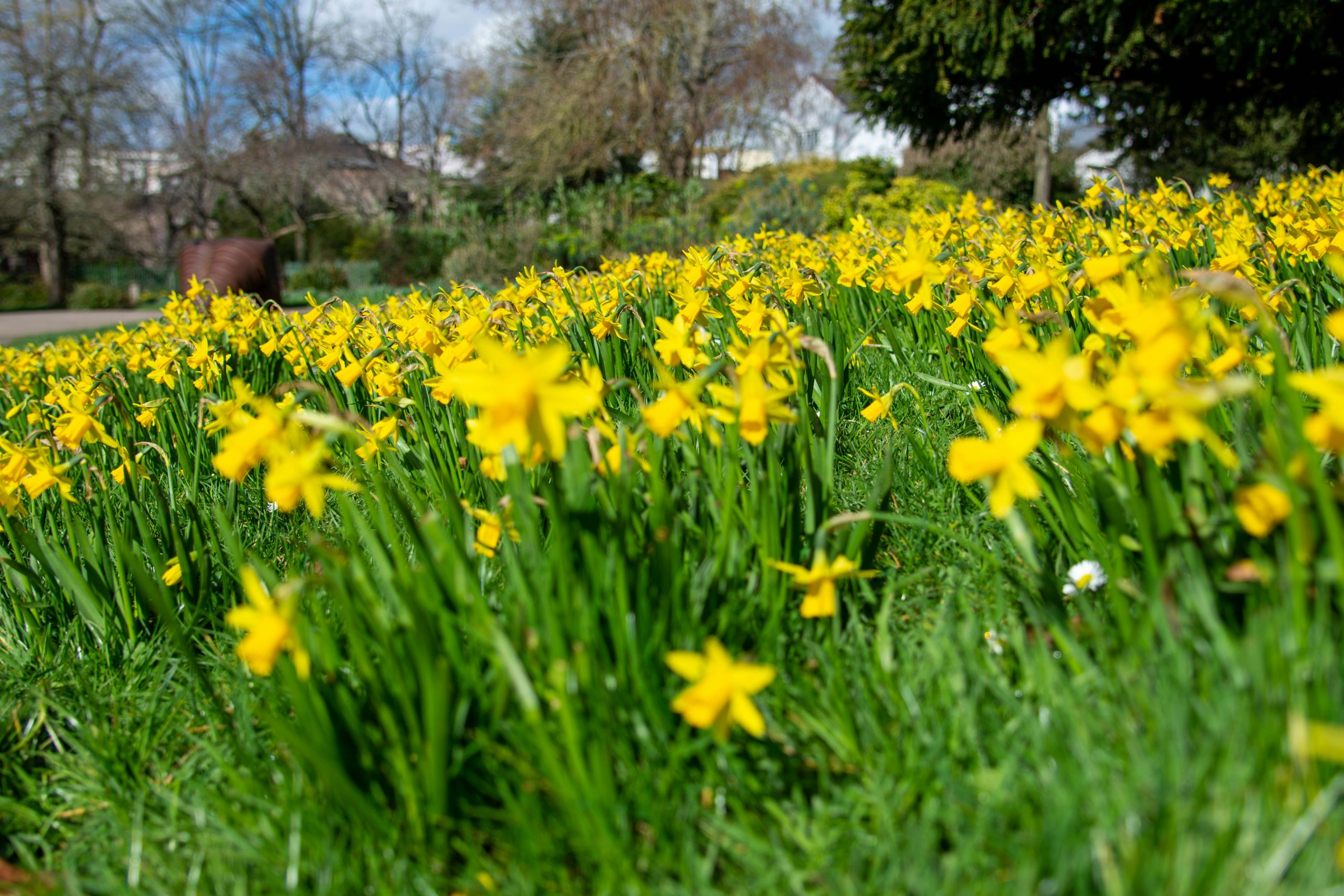
Where once the sidewalks had been lined with grey frozen puddles, now I walked past hundreds of daffodils. Their yellow blossoms would bob in the wind, and I imagined that they were waving at me. They immediately made me think of Wordsworth’s famous poem “I Wandered Lonely as a Cloud“:
I wandered lonely as a cloud
That floats on high o’er vales and hills,
When all at once I saw a crowd,
A host, of golden daffodils;
Beside the lake, beneath the trees,
Fluttering and dancing in the breeze.
In a way, the sight of the daffodils fell on me like an enchantment. With the warmer days, I’d go walking aimlessly for hours through Sheffield. In the frigid months, I never left my apartment except to attend class or make a run for groceries. Spending the first eight weeks of the semester cooped up in my room had stifled all of my creative energy. I hadn’t realized how much I needed to be outside, until I found myself craving daily walks.
Sometimes I’d decide on a destination, like the cafe with the mismatched furniture or the pub that was locally famous for its meat pies. Other times, I would walk a loop around the city and keep going until I got tired or hungry. I started to love the simplicity of walking, how I could let my mind wander, and how the rhythm of my footsteps lulled me into a meditative mood. I’ve never been fond of sitting alone with my thoughts—I’m prone to anxiety spirals. My brain, when left to its devices, gravitates towards catastrophizing.
But, somehow, walking allowed me to reflect, without spiraling. And in those reflective moods, my imagination stretched its legs too. I didn’t get the instant gratification of going for a walk, and coming home to draft a new poem. It was more like my creative mind was nearer to the surface than it had been before, like a burrowing creature waking from hibernation, or like a migratory bird returning for the warm weather.
Walking in the Age of Distraction
I think about Wordsworth and his walking habits often these days. I don’t think it’s farfetched to suggest that his outdoor walks influenced his writing—though, of course, he didn’t have to contend with emails in the eighteenth century. I’m convinced that our literary predecessors had the advantage of the absence of cars and modern technology. They had more time to write, without an hour-long commute to work; they had fewer distractions, without iphones!
A 2014 Stanford study determined that walking increases our capacity to think creatively. Surprisingly, the researchers found that even walking indoors on a treadmill had a significant positive impact on the participants creativity. So, as it turns out, even walking inside on a treadmill has benefits! But when the sun is shining and the first blooms of spring are peeking up from the newly thawed ground, I want to be outside.
In the United States, so many cities are car-dependent, and access to safe places for walking isn’t a guarantee. In Atlanta, I’m fortunate to live in an area that has invested in pedestrian infrastructure like sidewalks. But still, if I want to walk from my house, I’m surrounded by busy roads. If I want to visit a park, I’d have to hop in my car and drive several miles to reach a green space. Despite these little inconveniences, I’m always eager for those early days of spring, daffodil season, when the flowers start to unfurl, and robins gather all around my neighborhood. I’m ready to cast off my winter hibernation, and step outside into the sun.
References:
Gaillet-De Chezelles, Florence. “Wordsworth, a Wandering Poet: Walking and Poetic Creation.” Études Anglaises, Vol. 63, 2010. p.18-33. CAIRN, https://shs.cairn.info/revue-etudes-anglaises-2010-1-page-18?lang=en#s1n7. Accessed 9 February 2026.
Wordsworth, William. “I Wandered Lonely as a Cloud.” Poetry Foundation, https://www.poetryfoundation.org/poems/45521/i-wandered-lonely-as-a-cloud. Accessed 9 February 2026.
Wong, May. “Stanford Study Finds Walking Improves Creativity.” Stanford Report, 24 April 2014. https://news.stanford.edu/stories/2014/04/walking-vs-sitting-042414. Accessed 9 February 2026.